IISER Pune Scientists Develop Faster, More Sensitive RNA Test for COVID-19, Zika
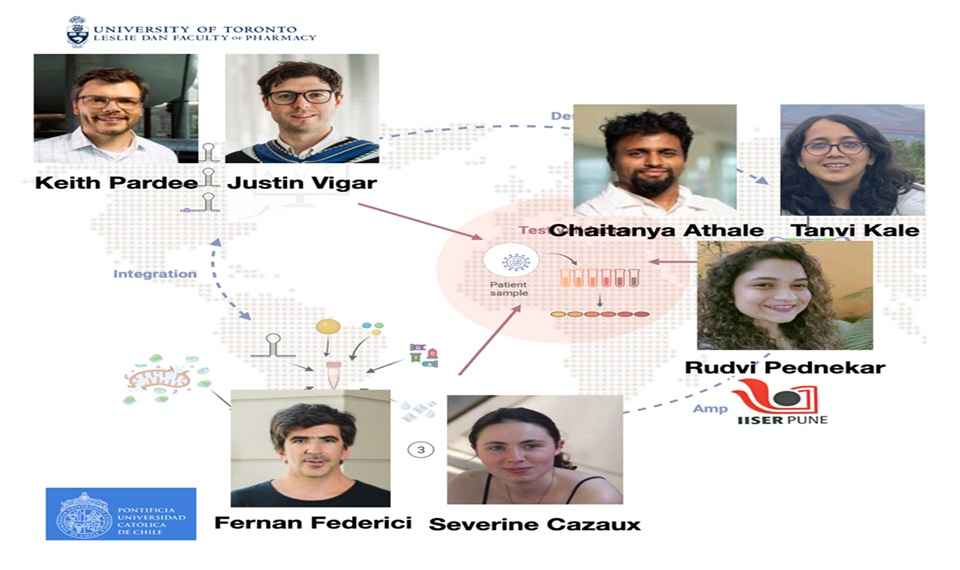
Pune, 14th June 2025: In a recent study published in ACS Synthetic Biology [1], Tanvi Kale, Rudvi Pednekar and Chaitanya A. Athale from the Department of Biology at IISER Pune, in collaboration with the research teams of Dr. Keith Pardee (University of Toronto, Canada) and Dr. Fernán Federici (Pontificia Universidad Católica de Chile, Chile), have developed a strategy to significantly enhance the sensitivity of RNA-based biosensors called toehold switches.
This work was funded by both the Shastri Indo-Canadian Institute (SICI) and an international consortium supported by the International Development Research Centre (IDRC) Govt. of Canada. The consortium aimed to develop accessible, field-ready diagnostics for global health challenges using synthetic biology.
The approach taken uses a technique referred to as “toehold switches”, that has previously been demonstrated to be successful for the detection of molecular signatures of viruses and other pathogens. These are programmable ribonucleic acid (RNA) sequences which, in presence of viral RNA, will produce a color signal due to a combination of enzyme production and colored substrate – thus serving as a “genetic device”.
Such devices are promising for low-cost, portable diagnostics in low-resource settings, as shown in the previous work from Dr. Pardee’s research group during the Zika virus outbreak in Brazil. One limitation in this previous approach was the number of steps involved in obtaining sufficient signal amplification.
In this collaborative study, the researchers addressed this limitation by incorporating short genetic sequences known as “translational enhancers” upstream of the toehold region, resulting in increased protein expression upon target detection. The improved sensors were tested using RNA sequences from SARS-CoV-2 and Zika virus (ZIKV), and successfully validated in cell-free systems. This potentially points to a proof-of-concept of a paper-disc based molecular diagnostic test, relevant for point-of-care (PoC) use in low-resource environments.
This research received funding from the Shastri Indo-Canadian Institute (SICI) Shastri Covid-19 Pandemic Response Grant (SCPRG) to Prof. Chaitanya Athale, along with other grant support to his collaborators.