IISER Pune Student Protest Enters Third Day as Students Demand Direct Talks, Mental Health Reforms
Reported by Shoaib Tadvi
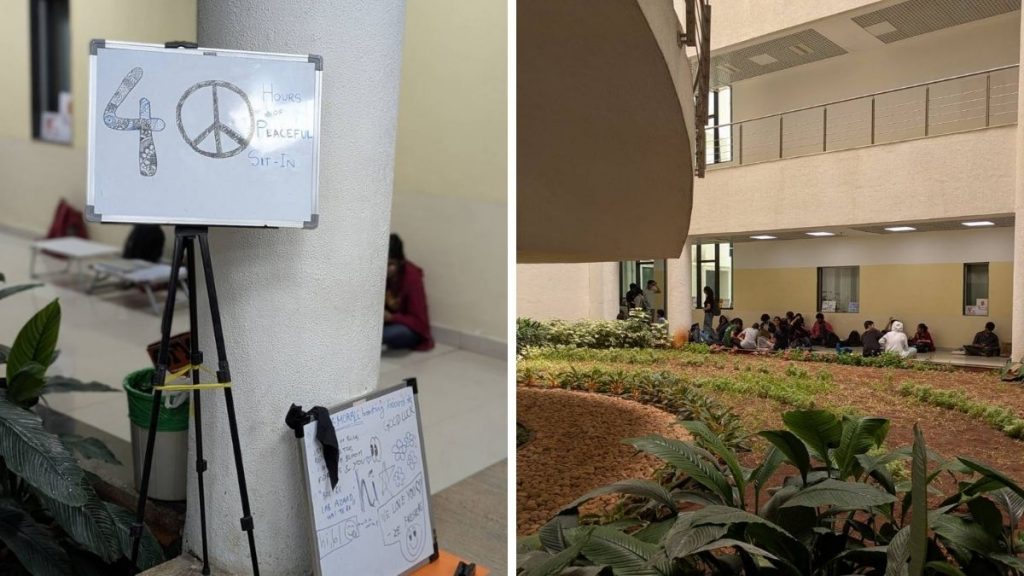
Baner, 29th August 2026: Hundreds of students at the Indian Institute of Science Education and Research (IISER) Pune have continued their peaceful sit-in for more than 48 hours, demanding direct talks with the institute’s Director and reforms in mental health support, student representation and campus regulations.
The protest entered its third day on Saturday after beginning on Thursday, when hundreds of students gathered at Baner Gate to protest what they described as administrative apathy and a failure to address student concerns. Following the demonstration, students moved to an indefinite sit-in inside the campus and have maintained a continuous presence near the offices of the Director and Deans.
According to protesting students, the movement is the culmination of months of concerns over what they describe as inadequate mental health infrastructure, difficulties in communicating with the administration, restrictions affecting student life and disciplinary action against an elected student representative.
As the protest crossed the 48-hour mark, students’ central demand has become a direct and formal dialogue with Director Prof. Sunil Bhagwat.
Mental Health Concerns at the Centre of Protest
Mental health support is among the major issues raised by students.
Students have alleged that those seeking counselling or psychiatric assistance have faced long waiting periods and difficulties accessing professional support. They argue that the issue is not simply the number of counsellors appointed by the institute, but whether students experiencing distress can receive timely and confidential assistance.
The administration, meanwhile, has said that IISER Pune has two full-time counsellors and two additional part-time counsellors working through its Mental Wellbeing Centre. The institute is also in the process of hiring one to two additional full-time counsellors. A psychiatrist is connected with the institute on an as-needed basis, according to the administration.
Students, however, say these measures do not adequately address their concerns about accessibility, confidentiality and timely intervention.
The issue gained further attention following the August 16 death of a female student. There is no established public finding linking the death to disciplinary proceedings against any student or to institutional failures. However, the incident has intensified discussions among students about mental health, institutional support and whether warning signs and student concerns were being adequately addressed.
For the protesting students, the larger question is whether the existing campus support system is sufficient to respond to students experiencing serious emotional or psychological difficulties.
Suspension of Student Representative Adds to Distrust
Another major issue is the disciplinary action taken against Student Council General Secretary Raj Bagwe.
The IISER Pune administration has maintained that Bagwe’s disciplinary proceedings were related to a separate misconduct incident and followed due process. The institute has also clarified that the matter was unrelated to the August 16 student death.
According to the administration, a detailed enquiry was conducted before disciplinary action was taken. It further said the appellate authority subsequently reduced the punishment after finding that the student was apologetic and repentant, and that the matter is now beyond the institute’s jurisdiction.
Students, however, have presented a broader argument.
They say the disciplinary action against an elected student representative weakened an important channel of communication between the student community and the administration.
According to them, concerns related to mental health and campus welfare were not reaching the administration effectively.
Their argument is not necessarily that Bagwe’s disciplinary action caused any particular incident, but that it contributed to what they describe as a wider breakdown of trust and communication.
His reinstatement and the protection of student representation have therefore become central demands of the movement.
Hostel Rules and Restrictions on Student Life
Students are also protesting against what they describe as gendered mobility restrictions in hostels.
The administration has defended the restrictions, saying they were implemented more strictly after some female residents raised concerns about their safety. According to the institute, boys are prohibited from entering girls’ rooms and other residential facilities, and vice versa.
The administration said common areas on the ground floor of all hostels remain accessible to students.
Students, however, argue that their concerns have been misunderstood. They say they are not demanding unrestricted access to every hostel area, but are seeking reasonable provisions for PhD scholars living on campus who have spouses, partners or children and want to meet their family members.
The students are seeking a review of rules and regulations they consider excessively restrictive.
The administration has also said that IISER Pune has seven dedicated married apartments in the hostel complex and that there are currently no pending requests for married accommodation.
Students Demand Common and Collaborative Spaces
The lack of accessible common spaces has also emerged as a major issue.
Students have demanded the restoration of hostel common rooms and club spaces, arguing that such facilities are necessary for collaboration, group work, social interaction and student activities.
The institute has previously said it plans to develop additional sitting and co-working spaces by renovating the Dining Complex. These spaces will be separate from the dining area and will be made available for student activities, according to the administration.
Students, however, argue that one central facility cannot replace dedicated common spaces within residential areas and across the campus.
Their demand, they say, is therefore not merely for additional infrastructure, but for spaces where students can interact, collaborate and build a stronger campus community.
From Individual Issues to a Larger Movement
Taken together, these issues explain why the current protest has grown beyond a single demand.
Students say concerns related to mental health, representation, hostel regulations and common spaces have existed separately for some time. The current movement has brought them together under a broader demand for accountability and meaningful dialogue.
The August 16 student death intensified discussions surrounding mental health and institutional support, while disciplinary action against the Student Council General Secretary added to concerns about student representation and communication.
The result, according to protesting students, has been a growing sense that individual complaints were not being adequately addressed and that a collective demonstration was necessary to secure direct engagement with the administration.
Students Seek Direct Talks With Director
During the ongoing sit-in, students were contacted by the Dean of Student and Campus Activities (SCA), who asked them to submit their demands.
Students, however, first sought assurances that those participating in the peaceful protest would not face disciplinary action.
On Friday, they informed the Dean that they were willing to hold a direct and formal discussion with the Director. They sought an open meeting, advance communication to the IISER Pune community and permission to record the discussion.
In an internal email sent on August 28, Director Prof. Sunil Bhagwat stated that the institute would not initiate disciplinary action against students participating in or organising the peaceful campus sit-in as long as the protest remained peaceful, involved no violence, did not disrupt essential institute operations, involved no unlawful acts and did not include communication violating applicable laws or institute IT policies.
The institute subsequently clarified to students that participation in the peaceful sit-in itself would not be treated as a violation of institutional rules. However, violations of institutional rules or Indian laws would be considered unlawful, according to the administration.
The Director has also invited three to five representatives of the protesting students for talks. However, students have not yet agreed to the proposed format, according to the institute.
The administration also said the students had not officially submitted their list of demands to the institute as of Saturday.
Police Presence at Protest Site
Police personnel from Chaturshringi Police Station also approached students at the protest site on Friday evening, according to the demonstrators.
Students further claimed that plainclothes police personnel were present near the protest location on Thursday evening.
Despite the prolonged sit-in, students said the protest has remained peaceful.
Students have continued their presence overnight and into the third day, sharing messages of solidarity and maintaining that they will continue the demonstration until meaningful dialogue takes place.
What Do Students Want?
The key demands emerging from the protest include:
Stronger and more accessible mental health infrastructure.
Timely access to counsellors and psychiatric professionals.
Greater confidentiality in mental health services.
Review and rollback of gendered hostel mobility restrictions.
Functional and gender-neutral common spaces for students.
Protection of peaceful student demonstrations from disciplinary retaliation.
Restoration and strengthening of student representation.
Revocation of disciplinary action against Student Council General Secretary Raj Bagwe.
The Core of the Standoff
At its core, the IISER Pune protest reflects a disagreement not only over individual policies but also over how student concerns should be heard and addressed.
The administration has maintained that it has followed due process in disciplinary matters, strengthened mental health services and introduced measures addressing safety and student infrastructure.
Students argue that these measures do not sufficiently address the underlying issues they have raised.
For the students sitting outside the offices of the Director and Deans for more than 48 hours, the immediate demand remains a direct conversation with the institute’s highest decision-making authority, along with concrete assurances that their concerns will lead to meaningful institutional action.
As the sit-in enters its third day, whether direct talks between the students and the IISER Pune administration can break the current deadlock remains to be seen.