JEE Advanced 2026: What IITians Do in the Last 2 Weeks
Pune, 04 April 2026: The JEE Advanced is just around the corner, and this is the time when mindset begins to play a much larger role than pure study. If you can conquer your mindset, you get close to those who are dominating the world. The founders of companies like Zomato, Ola, Flipkart, NoBroker, and Snapdeal are pros with this mindset. Although they are from IITs, they are not directly using PCM (Physics, Chemistry, Maths) or engineering in their current roles, yet they are doing exceptionally well. Even successive Governors of the RBI, chiefs of international giants like Google, IBM, McKinsey, Twitter, and Boeing, or thousands of IAS/IPS officers have same thing in common. More than their knowledge of PCM/engineering they learn during their IIT days, their capability to focus on the right things at the right time that makes them who they are. Now as JEE advanced is approaching, it is your turn to master these skills of controlling your mind. Many students get confused and sometimes anxious in the last two weeks before the great JEE Advanced.
JEE Advanced tests how you respond when faced with a problem unlike anything you’ve seen before. More than your memory, the exam is testing your grit, your fundamentals, and your ability to stay calm when the “processor” in your head starts to overheat.
As you enter the final stretch for 2026, the shift from “learning” to “strategizing” is what separates the rankers from the rest.
Why Is Your Brain’s “Processor” More Important Than the Syllabus?
Your result will depend on your score, and that will depend on how well you studied and, more importantly, how well you plan the next two weeks. You cannot change the past, but you can certainly extract the maximum out of the next 14 days. Think of your brain like a computer. It has a finite amount of “processing power” (RAM). If you engage 40% of that processor in worrying about your rank, your parents’ expectations, or “what if” scenarios, you only have 60% left for actual preparation. Not only have you wasted your processing units, but you are also creating unnecessary anxiety. If worrying about results helped, your mentors would have included it in your curriculum.
Just remain in the moment. When you get up, tell yourself: “No matter what I did until today, I will not waste a single minute today.” Plan and execute. Repeat this for the next two weeks. Go with a degree of tolerance; don’t aim for 100% perfection. Instead, aim for 100% focus on the task at hand, whether it’s revision or a mock test. This is the daily input that will truly matter. A happy mood during the last 10 to 12 days plays a huge role in the exam as well. A sense of satisfaction with 100 units of concepts in mind is far better than a dissatisfied mind with 120 units.
Avoid the “New Topic” Trap: This is a low-scoring exam. It doesn’t matter how many things you know; it matters how well you know them. Focus on your strengths. If a topic is weak, just glance through it, but don’t try to master it now. Do not get stuck on a single problem, and avoid talking to negative people.
Train Your Body Clock to Peak at 9 AM, Not 11 PM
If you’ve spent the last six months peaking at 11 PM because that is when “you study best,” you must realise that JEE Advanced needs you sharp from 9:00 AM, when Paper 1 begins, all the way to 5:30 PM, when Paper 2 ends. That is an 8.5-hour performance window in which your body and brain must be at their absolute best.
This is what we call biological time-setting, and it is non-negotiable in the last 14 days. The human body runs on a circadian rhythm, a 24-hour internal clock that decides when you feel alert, when you feel sleepy, and when your digestion, blood pressure, and focus peak. If your clock is set to “alert at midnight, sleepy at 10 AM,” no amount of last-minute willpower will fix that on May 17. You have two weeks to reset it, and that is exactly enough.
Starting today, sleep by 11 PM and wake by 6:30 AM. Eat your breakfast by 7:30 AM so digestion is done before Paper 1 begins. A heavy meal at 8:30 AM means your blood is busy in your stomach instead of your brain. Use the 12 PM to 2:30 PM gap exactly the way you will use it on exam day: a light lunch, no heavy nap, no scrolling.
Pair this body-clock reset with strict mock test discipline. Take one full-length mock every alternate day, and at exam timings only: 9 AM for Paper 1 and 2:30 PM for Paper 2. Spend the next day analyzing it: which questions you got wrong, where you wasted time, where panic crept in. The marks are hidden in the analysis, not in the next mock. Five mocks back-to-back without analysis is just five wasted days.
Are You Actually Competing Against 2.5 Lakh Students? The Surprising Truth Behind the Stats
The 2.5 lakh “competitors” you see on paper are largely a myth. The real competition is much thinner than it appears. Typically, only about 1.8 lakh students actually appear for the exam. Thousands are disqualified before the first bell rings. Many are in their third attempt (Advanced only allows two), and many more are out because they didn’t meet the 75% board criteria. A huge portion of the remaining students is defeated by their own nerves. Anxiety pushes them out of the game.
You need to stay focused until 5:30 PM on May 17th. If you can maintain your health (poor health can cost you 20 to 30 marks!) and avoid getting drawn into comparisons, you are already ahead of the majority.
Could a Single Decimal Point Destroy Your Rank? Decoding the Roorkee Challenge
With IIT Roorkee setting the paper for 2026, you must walk in with zero assumptions. They are famous for “balanced” papers, but they often play around with the pattern. Your exam starts with the instruction page. Read every word. If you don’t read it, you’re driving blind.
Unassisted Questions: These are questions without options (Integer/Numerical type). In 2025, nearly half the paper was unassisted, and the qualifying cutoff fell to around 20%. In MCQs, if you make a mistake, you will get a red flag by looking at the options. However, in unassisted questions, a minor decimal error means a 100% loss of marks and time. In 2025, many “top” students walked out of the hall smiling, not realizing they had lost massive marks to small slips. On the other hand, many who were not even close to them unexpectedly achieved good ranks. In such unassisted papers, or when the difficulty level is high, play on the “backfoot.” Accuracy is your greatest weapon. Go slow to ensure you are correct.
Lean on the People Who Know You Best
You must be close to a few of your teachers. “Eat their brain” whenever you need to; don’t think twice about approaching them. All good institutes ensure that you get to connect with your teachers who can mentor you outside the class. They know your behavioral patterns and will be happy to assist you.
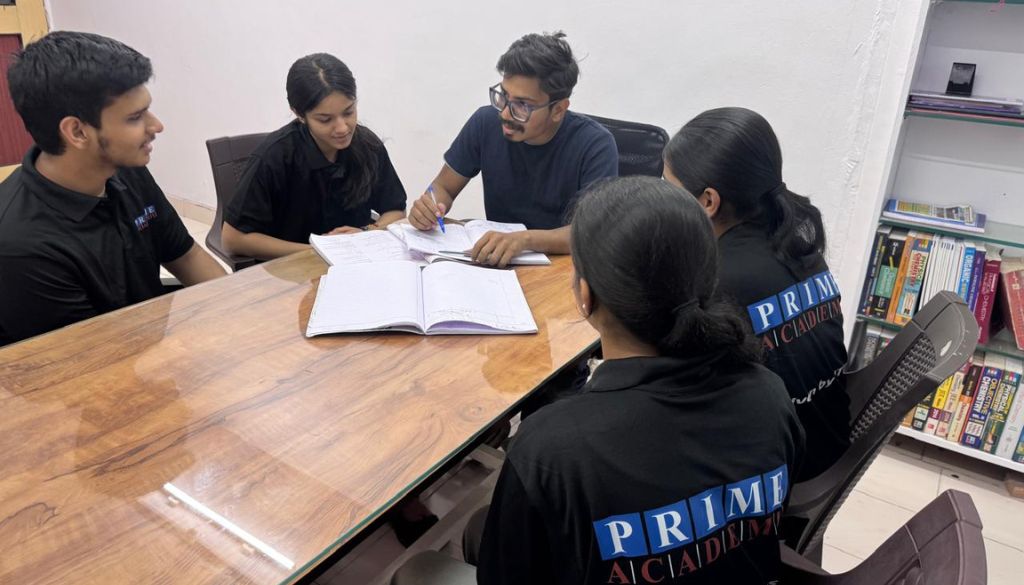
“We are conducting daily sessions with JEE Advanced appearing students and have told them that we are just one call or message away,” said Lalit Kumar, CMD of Prime Academy Pune, an institute where the same set of teachers has been mentoring students for 16 years, producing many IITians year after year from a small batch with one of the best IIT-JEE success ratios in the country.
The most important 24 hours are the ones just before the exam. To ensure you don’t burn out or let “exam fever” cloud your judgment, Mr. Lalit Kumar, on behalf of Punekar News, will be conducting a vital Strategy and Anxiety Management Session on May 16th at 11 am.
This is not a generic pep talk. Mr. Kumar will get into the specifics which many students miss out. These are the small things that will impact your performance on May 17:
- Why you must NOT calculate your score between Paper 1 and Paper 2, and how to use that 2.5-hour lunch gap to recharge your “mind battery” for an even sharper second half.
- A quiet briefing for parents: the one question you must NOT ask your child between papers (it has cost more ranks than any tough Maths question), and what to say instead.
- How to handle the unexpected: what to do if the fingerprint scanner fails and eats 5 minutes of your time, if your monitor suddenly switches off mid-question, if a network glitch freezes your screen, or if you blank out on a problem you have solved a hundred times before. There is a protocol for each. Many students do not know it, and they panic.
- The “last night” playbook: what to eat on the evening of May 16, what time to sleep, what to revise (and what to absolutely NOT touch), and the one mental drill to do the moment you sit down at your computer on May 17 morning.
Those looking for additional tips for the last day and, more importantly, the right mindset for the exam should join this session to ensure their “processor” stays cool under pressure. You can attend the session live on the Prime Academy YouTube channel youtube.com/@PrimeAcademyIITJEE
Remember, the JEE Advanced is ultimately a test of character. Handle the paper one task at a time, and let your score speak for itself. We look forward to seeing you on the 16th!