Pune: PMC Fast-Tracks Mohammadwadi–NIBM Pipeline, Water Supply Likely by May 15
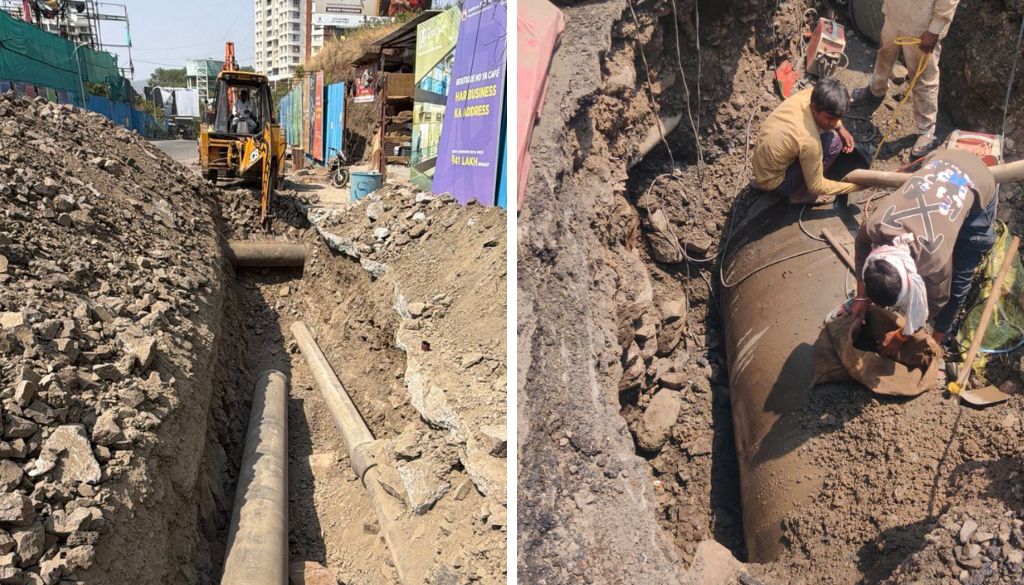
Mohammadwadi, 28th April 2026: The Pune Municipal Corporation (PMC) Water Supply Department has intensified work on the long-delayed pipeline network in the Mohammadwadi–NIBM Annexe corridor, shifting the project into full mission mode with engineers and contractors working day and night to meet a critical deadline of May 15. The plan is to finally begin water supply into the three Dorabjee storage tanks—assets that were built nearly a decade ago but remained underutilised due to incomplete feeder pipeline connectivity.
This renewed urgency comes against the backdrop of a much larger, long-standing problem: nearly two decades of heavy tanker dependency in Mohammadwadi, NIBM Annexe, Undri, and adjoining pockets. As the area transformed from semi-rural outskirts into a dense residential hub, rapid construction outpaced civic infrastructure. Despite thousands of families moving in, municipal water supply remained inconsistent or incomplete in several pockets, forcing residents and housing societies to rely heavily on private water tankers for daily needs.
Over time, this created a parallel water supply system in the area:
Residential societies routinely depended on multiple tanker deliveries per day
Commercial establishments scheduled operations around tanker availability
Internal roads became congested with tanker queues, especially at filling points
Traffic flow and safety were repeatedly impacted due to heavy vehicle movement in narrow residential lanes
Residents say this dependency has not only been expensive and unreliable but also increasingly unsafe, especially in recent years when tanker-related accidents have raised serious concerns about road safety in dense housing zones.
The urgency to complete the pipeline gained further momentum after a series of fatal accidents involving tankers in Pune’s southern suburbs, including incidents that claimed the lives of Aariz Shaikh in Mohammadwadi, Gracia Daniel Isa in the Wanowrie–Kadnagar belt, and Pratik Ashwin Sheth in Hadapsar. These incidents intensified public pressure on the civic administration to reduce tanker movement by strengthening permanent water infrastructure.
Against this backdrop, Additional Municipal Commissioner Pavneet Kaur recently visited the Mohammadwadi–NIBM Annexe area to review the stalled work and interact with residents. During her visit, she assured citizens that the PMC would fast-track execution and committed to a firm deadline of May 15 for initiating water supply to the Dorabjee tanks.
Following her intervention, the pace of execution has visibly increased. Multiple teams have been deployed across stretches simultaneously, with trenching, pipe-laying, and connection work progressing in parallel. Night shifts have been introduced to ensure continuity and avoid delays caused by traffic disruptions during the day.
Residents have acknowledged the visible change in momentum.
“For nearly two decades we have depended on tankers for even basic daily needs. Now, for the first time, we are seeing real urgency on the ground—work is going on day and night without pause. This kind of sustained effort gives us confidence that the long-pending water pipeline project will finally be completed on time,” said Raj Singh.
“The situation here has always been difficult because infrastructure never kept pace with development. If this pipeline becomes operational, it will finally reduce our dependence on tankers,” said Sunil Iyer.
“This is not just about water supply—it is about safety and order on our roads. Fewer tankers will directly improve traffic conditions,” added Sunil Koloti.
If completed on schedule, the commissioning of the Dorabjee tanks and associated pipeline network is expected to mark a major transition point for the region, reducing long-standing tanker dependence, easing road congestion, and finally aligning basic water infrastructure with the scale of residential growth in Mohammadwadi–NIBM Annexe.