Tomb of Cynthia Farrar, Savitribai’s teacher, found in Ahilyanagar
Reported by Camil Parkhe
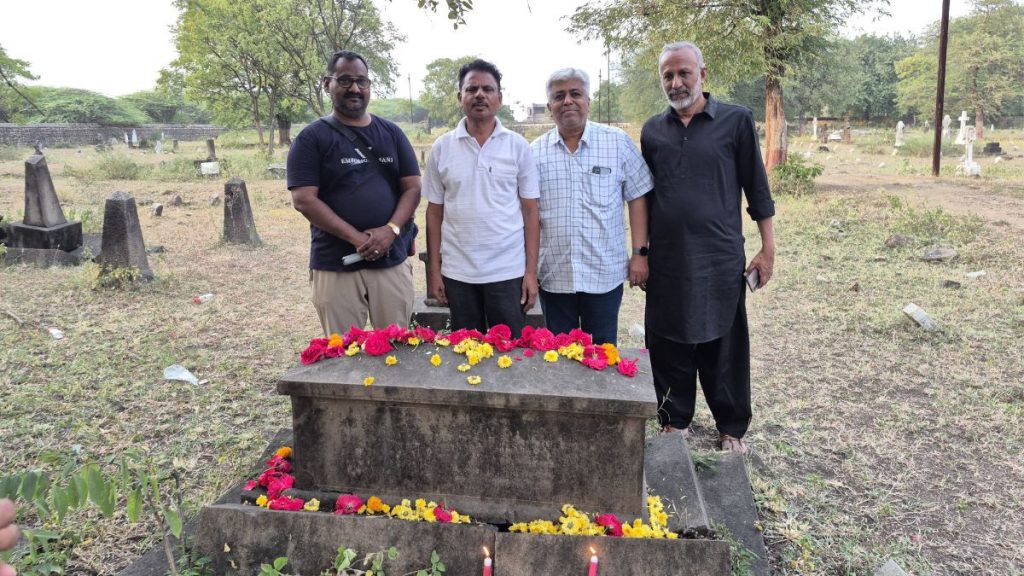
Ahilyanagar, 20th October 2026: The tomb of Miss Cynthia Farrar, an American Christian missionary who gave lessons to Savitribai Phule in teaching, has been discovered in a Christian cemetery at Burhannagar near the Delhi Gate in Ahilyanagar on Friday, October 16.
The final resting place of the missionary was discovered by a team of Ahilyanagar-based Itihas Premi Mandal members Abhijit Eknath Wagh, an engineer, Bhairavnath Wakale, a journalist and also a former corpotaor of the Ahilyanagar Municipal Corporation, and Asif Khan Dule Khan, a tailor by profession.
The trio history researchers had been in search of Cynthia Farrar’s tomb for the past two years. There are two Christian cemeteries in Ahilyanagar. The researcher’s earlier search for Farrar’s tomb at the other Christian cemetery at Siddharth Nagar near Bhingar Camp in the city had not yielded any result.
Cynthia Farrar who ran girls schools and boardings initially in Mumbai and later in Ahilyanagar is also credited with inspiring Mahatma Jotiba Phule to undertake female education work.
The Phule couple is revered for their service in opening the doors of education for the first time in modern times to women and the downtrodden sections of society.
The educationist missionary’s grave which had been lying ignored at the Christian cemetery for over 150 years was surprisingly found in a good shape.
The inscription on the tomb of the missionary reads:
“In the memory of Miss Cynthia Farrar of the American Mission Born April 20, 1795 Died January 25, 1862. For 35 years she laboured for the education and spiritual enlightenment of Hindoo females. Her works do follow her.’’
Incidentally, Cynthia Farrar’s grave has been discovered during the present second birth centenary celebrations of Jotiba Phule.
A couple of years ago, I had stumbled upon the name Cynthia Farrar and then I had looked for historical references to verify whether the American missionary had really inspired Savitribai and Jotiba Phule to take up the mission of female education.
The search paid rich dividend as I discovered several references to this missionary in the voluminous records and annual reports of the American Marathi Mission, starting from 1832 and stretching over a century. My research led me to write Cynthia Farrar’s first biography, entitled in Marathi ‘Savitribai Phulenchya Shikshika Cyntia Farrar.’
In his deposition to the Sir William Hunter Education Commission on 19 October 1882, Jotirao Phule has spoken in following words about his association with the Christian missionaries.
“My experience in educational matters is principally confined to Poona and the surrounding villages. About 25 years ago, the missionaries had established a female school at Poona, but no indigenous school for girls existed at the time. I, therefore, was induced to establish such a school, and in which I and my wife (Savitribai) worked together for many years.
Cynthia Farrar, born in America on April 20, 1795, had arrived in Mumbai on December 29, 1827. She devoted her life for women’s education until her death at the age of 67 years.
Dhananjay Keer in his biography ‘Mahatma Jotirao Phooley: Father of the Indian Social Revolution’ has written how Cynthia Farrar madam inspired Jotiba Phule.
“In 1848 Jotiba’s bosom friend Sadashiv Ballal Govande, who was in service with the Inam Commission, was transferred to judge’s office at Ahmednagar, which was a well-known centre of Missionary schools. The strong man and the waterfall, says the proverb, channel their own path. When Jotiba was about to start a girl’s school he went to pay a visit to his friend Sadashiv Govande at Ahmednagar.
I visited, while at Ahmednagar, in company with a particular friend, the female schools belonging to the American Mission conducted by Miss Farrar and was highly pleased with the manner in which the girls in those schools were educated. Miss Farrar expressed to Jotiba and Govande great sorrow at the foreigners’ perseverance in improving their country and felt for their neglect of female education in this country. They were impressed by the countrymen’s neglect of it.
“Immediately on my return to Poona,” Jotiba continues, “I opened a Low Caste Female school, allowing, however such boys as wished to do so to attend also. In this, I commenced to teach reading, arithmetic and the elements of grammar.”
American Marathi Mission’s report for 1862 carries the sad news of death of Miss Cynthia Farrar on January 25. It says: “We cannot mourn for her, she has gone to her rest and to her reward on high. Her works do follow her.”
These last words ” Her works do follow her” carried in Farrar’s obit have also been inscribed in the stone tomb of the missionary which was discovered last week.
Incidentally, Farrar’s school located near the Maliwada Bus Stand in Ahilyanagar, is still functional on its spacious premises to this date. The school was renamed as `Clara Bruce Girls School’ five decades ago. Clara Bruce was the school’s principal for many years in later period.
Clara Bruce Girls School is indeed a memorial of Cynthia Farrar and needs to be preserved. The contribution in educational field made by Savitribai and Mahatma Jotiba Phule were also in a way continuation of the service pioneered by Cynthia Farrar.