Air Pollution: ARAI creates emission inventory for Pune district
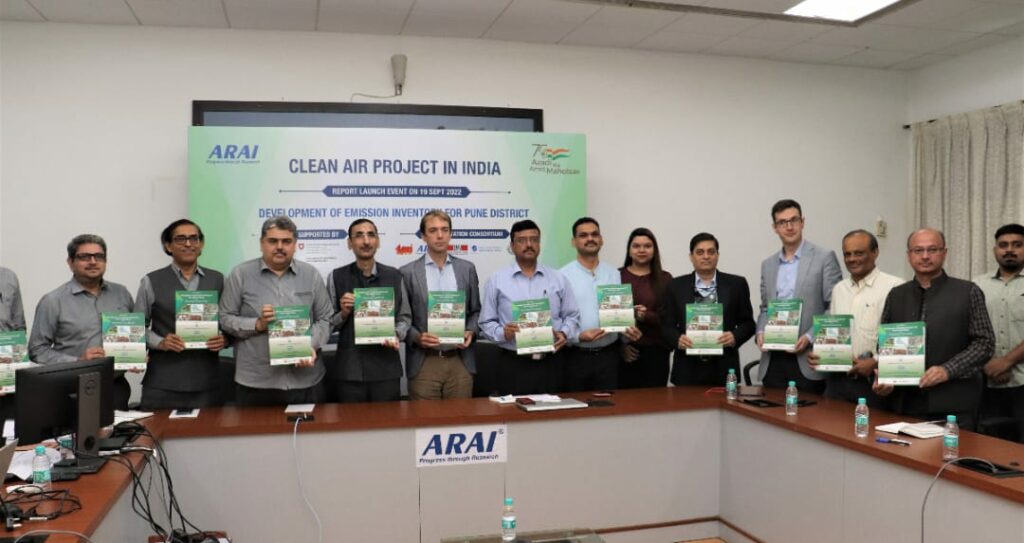
Pune, 19th September 2022: City-based Automotive Research Association of India (ARAI) has formulated gridded emission inventory for Pune district as an initiative towards air quality management. This inventory identifies key sources of air pollution and their contributions. The CAP India project implemented by a consortium of institutions led by TERI, New Delhi is undertaken to assist stakeholders such as MPCB and PMC in effective implementation of an action plan for air quality management. The Pune project component is executed by ARAI.
This was announced today during a press conference held at ARAI where the Emission Inventory Report was presented. Those who were present for the press conference included A. A. Deshpande (Sr. Deputy Director), Dr. S. S. Thipse (Sr. Deputy Director) and Moqtik Bawase (General Manager) from ARAI, R. Suresh (Fellow and Area Convener) from TERI and Dr. Jonathan Demenge (Head of Cooperation [New Delhi]), André Daniel Mueller (Programme Officer), and Dr. Anand Shukla (Senior Advisor) from Swiss Agency for Development and Cooperation (SDC), Madhav Jagtap (Deputy Municipal Commissioner – Environment) and Mangesh Dighe (Environment Officer) from Pune Municipal Corporation, Aniruddha Shahapure, Chief Knowledge Officer, Pune Smart City and other stakeholders working in the field of air quality management.
An important component– ‘Development of Emission Inventory for Pune District’ has been undertaken under the ‘Clean Air Project in India (CAP India), which is linked to the ‘National Clean Air Program’ launched in 2019 for better air quality in 132 non-attainment cities.
The emission inventory for baseline year 2021 has been developed using scientific tools and techniques and with due consideration to quality assurance and control aspects.
A dedicated team of about 30 members have worked extensively to generate the field data. Additionally, secondary data provided by MPCB and PMC was also included in the analysis. High resolution satellite images and GIS tools were utilized to identify the sources of air pollution.
There are five key pollutants – PM2.5, PM10, Carbon Monoxide (CO), Sulfur Dioxide (SO2) and oxides of nitrogen (NOX) and ARAI has identified sources of each of the pollutants in Pune district. The entire district, spread across 15,643 square kms, was divided into 2 km x2 km grids.
As per the inventory – for PM 2.5 is concerned, which is one of the important pollutants – the breakdown is – Transport – 20%, Road Dust – 19 %, Industries – 19 %, Agricultural Waste 10 %, Construction and allied sectors – 12 %, Residential and open waste burning – 6 % each and Diesel Gen-sets – 4 %.
With regard to CO – the breakdown found is as – Transport – 61%, Industry – 18%, Residential –8 %, Agricultural Waste Burning – 5 %.
The bifurcation for PM10 is – Road Dust – 35 %, Construction and allied sectors – 23 %, Industry – 14 %, Transport 10 %, Agricultural Waste Burning – 6 %, Residential – 4%.
For SO2, it is – Industry – 84 %, Diesel Gen-sets – 6 % and for NOX (Oxides of Nitrogen) – the bifurcation is – Transport – 71 %, Diesel Gen-sets – 15 % and Industry – 11 %.
The study was reviewed by Professor Mukesh Sharma of Indian Institute of Technology- Kanpur and Dr. Sachin Ghude of Indian Institute of Tropical Meteorology, Pune.
This emission inventory database will serve as a foundation for further air quality modelling analysis to assess control policies and transform them into an actionable plan for the stakeholders.
The SDC has funded five million Swiss Francs for the entire project from 2019-2023.
Speaking on the occasion, A A Deshpande said there was growing inclination towards e-mobility in Pune and it can be seen through the rising number of such two-wheelers and buses.
Dr S S Thipse outlined the efforts taken by ARAI to combat air pollution.
“ARAI is working on E20, that is a 20 per cent blend of Ethanol and Gasoline (petrol), benefits of its technology is lower emission and lower pollution and promotion of bio-fuel, which will benefit the agricultural sector in India,” Thipse said.
Thipse also termed Hydrogen as the cleanest fuel.
“Hydrogen is the cleanest fuel as it doesn’t contain carbon and is being promoted as a fuel for both IC Engines and Fuel Cell vehicles. The National Hydrogen Mission Plan, launched by Honourable Prime Minister of India Narendra Modi, seeks to create infrastructure and promote use of hydrogen in Indian vehicles.”