Economic Crisis Warning? PM Modi’s Public Appeal Sparks Political and Public Reactions
Reported by Titiksha Choudhary
Pune, 12th May 2026: Prime Minister Narendra Modi’s recent public appeals urging citizens to adopt austerity measures amid the ongoing West Asia conflict have triggered widespread political debate, with critics questioning both the timing of the message and whether the government is preparing the country for a deeper economic crisis.
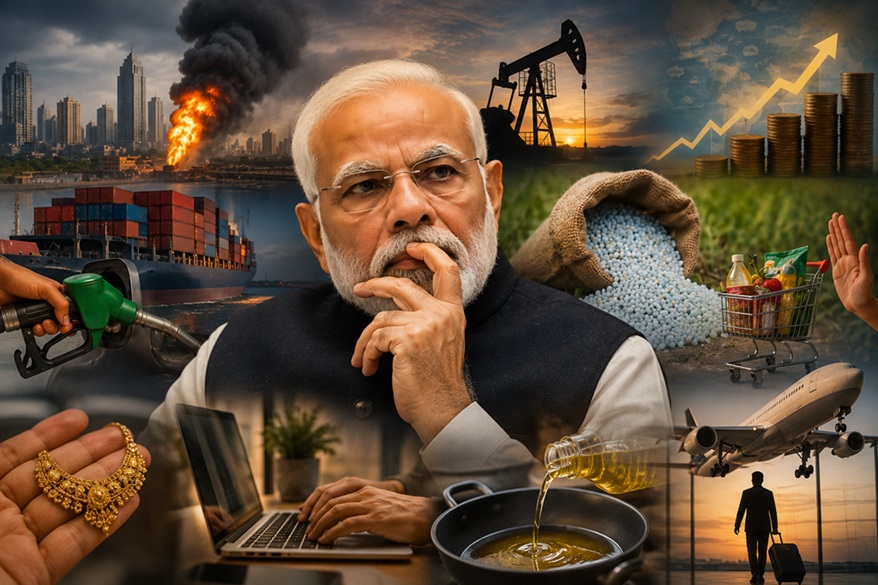
The conflict in West Asia has already affected several sectors linked to the Indian economy, including crude oil supply, fertiliser imports, and international trade logistics. Against this backdrop, Prime Minister Modi urged citizens to place the nation above personal comfort and adopt more self-reliant practices to help India navigate growing global economic uncertainty.
Speaking on May 10, Modi said patriotism today is not limited to sacrifice on the battlefield but also includes responsible economic behaviour during difficult times.
Among the key appeals made by the Prime Minister were:
- Prioritise work-from-home wherever possible
- Avoid purchasing gold for one year
- Reduce petrol and diesel consumption
- Cut down the use of cooking oil
- Reduce dependence on chemical fertilisers
- Prefer swadeshi products over foreign brands
- Avoid foreign travel for one year
The appeals quickly sparked political reactions and online discussions, with opposition leaders questioning why the government had not communicated these concerns earlier despite the West Asia conflict continuing for nearly two months.
Congress MP Karti Chidambaram questioned the intent behind the announcements and said the government should convene a Parliament session to discuss the issue openly with citizens.
He alleged that the public deserved greater transparency regarding the economic situation and asked whether the government was withholding difficult realities from the nation.
Critics also argued that while governments are elected to serve the people, it is often ordinary citizens who are asked to make sacrifices during periods of economic stress.
Anish Gawande, politician and national spokesperson, criticised the government’s messaging, saying, “It is deeply hypocritical for the government to ask people to cut down on cooking oil when they themselves spend millions flying ministers from one place to another. The government should lead by example. Charity begins at home.”
Social media users also expressed similar concerns. One X user, Abhinay Pandey, questioned whether austerity measures should first apply to political campaigns, official travel, large inaugurations, and government spending before appeals are made to citizens.
Several critics pointed out that political parties continue announcing welfare schemes and organising large public events during elections, despite citing economic strain linked to international developments.
Questions have also been raised about whether the government plans to formally implement any of these recommendations through policy decisions, including possible advisories to corporate companies regarding work-from-home arrangements.
At the same time, some citizens supported the appeals, arguing that precautionary steps may be necessary if economic conditions worsen further due to global instability.
Mahi Ashtekar, a 16-year-old student from Pune, said the suggestions appeared practical in principle but noted that affordability remains a concern for many families.
“Domestic products are often expensive. If people completely stop using foreign goods, it could become difficult for some families to afford basic necessities,” she said.
The debate surrounding the Prime Minister’s remarks has now expanded beyond economic caution to broader questions about governance, accountability, and whether public sacrifice is being matched by restraint within the political establishment itself.