From Graveyard to Fashion Street: The Vanishing Story of Pune’s East Street Cemetery
By Radhika Sharma
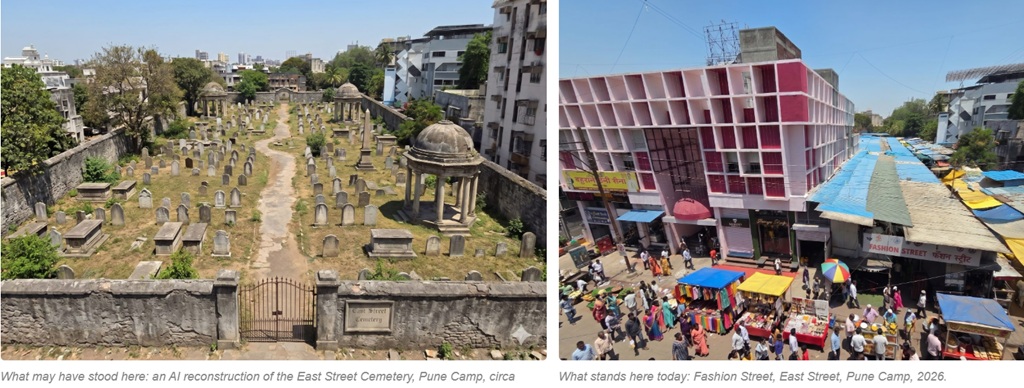
Camp, 25th April 2026: What becomes of memories a city no longer holds close? They recede quietly, sometimes taking entire landscapes with them. In Pune, one such vanished imprint is the East Street Cemetery, a burial ground believed to have been established around 1818, alongside the creation of the cantonment following the Third Anglo-Maratha War.
Once among the largest cemeteries in the old Poona Cantonment, the site is thought to have spread across nearly one-and-a-half acres. Today, it corresponds to the bustling stretch around Fashion Street, wedged between MG Road and East Street—a vivid contrast between a forgotten burial ground and one of Pune’s most vibrant shopping districts.
The cemetery is believed to have been established during the tenure of Mountstuart Elphinstone, placing it within an early phase of colonial urban planning in Pune. Yet, this layer of the city’s past rarely finds space in mainstream historical narratives, often overshadowed by Maratha-era landmarks and sites linked to India’s freedom struggle.
Its story resurfaced through the research of Rahul Ajmera, a Camp resident who traced archival references to the cemetery while studying 19th-century cantonment records. In his work You’ve Been Shopping on a Graveyard, Ajmera recounts how the site appeared in 1858 water supply documents, later marked as “Old Burial Ground” in 1874 and “Old Graveyard” in 1884.
What drew his attention was a trapezium-shaped plot between MG Road and East Street—an area he knew well but had never associated with a cemetery. Archival references pointed to around 231 graves, including British officers, civilians, children, and literary figures such as Maria Jane Jewsbury, Emma Roberts, and John Augustus Pope.
Ajmera describes the cemetery as an unlikely literary resting place and among the earliest burial grounds in the cantonment. As Pune expanded, burials gradually shifted elsewhere. “After 30 or 40 years, once the site got full, they expanded to other burial grounds… and this place eventually got into disuse,” he notes.
The cemetery’s historical importance was once formally acknowledged. In 1897, the Archaeological Survey of India documented “Old European Tombs” in the old Poona Zilla in its Revised List of Antiquarian Remains in the Bombay Presidency. By 1909, these were declared Protected National Monuments.
Yet, over time, the site slipped from institutional memory. In 2006, a survey presented in Parliament by the Archaeological Survey of India listed 35 protected monuments across India as “untraceable,” including the Old Poona Zilla’s European Tombs. As of 2024, the site reportedly remains among 24 such monuments that cannot be physically identified.
This raises a difficult question: how does a protected monument become untraceable?
For Ajmera, the answer lies partly in shifting cultural connections. “We can associate with Maratha heritage and Mughal heritage. But what relation do we have today with a British cemetery?” he asks. Over decades, as Pune urbanised and post-Independence priorities reshaped public memory, the site reportedly fell into disuse, was gradually levelled, and eventually absorbed into the city’s evolving commercial fabric.
A visit to the area today offers little hint of its past. In place of gravestones stands the sprawling Fashion Street market, created after hawkers from MG Road were relocated there over three decades ago. Rows of stalls selling clothes, footwear and accessories now define the space, drawing steady crowds and layering a new identity over what archival records suggest was once a burial ground.
That contrast—a thriving marketplace atop a forgotten monument—captures the essence of the East Street Cemetery’s story.
Ajmera also situates the cemetery within a broader network of colonial-era burial sites across Pune, including areas near St. Paul’s Church, Khadki and Ghorpadi, suggesting that the phenomenon of “untraceable” monuments may extend beyond a single location.
Historian Sanjay Deshpande views the issue through the lens of collective memory. “We need to know what is there, to decide what we want to keep and what we are willing to let go of,” he says, framing the cemetery as part of Pune’s layered urban narrative.
He notes that while the city has preserved many strands of its past, some histories—particularly those tied to the colonial period—have gradually receded from public consciousness. The “untraceable” label, he suggests, reflects evolving priorities of what communities choose to remember and preserve.
At the same time, Deshpande resists framing the story purely as loss. Heritage walks, independent researchers and local historians continue to bring lesser-known histories into conversation, even as many such sites remain underexplored.
“Don’t think of monuments just as stone or brick. There are stories behind them… only then will we value them,” he says.

Perhaps that is the enduring significance of the East Street Cemetery. Even where physical traces have dissolved into the cityscape, fragments of its story survive—in maps, records and recollections.
And in those fragments lies a larger question for Pune: not just what has been lost, but what it still chooses to remember.