Naneghat: Where Waterfalls Rise and History Whispers Through the Sahyadris
Reported by Shoaib Tadvi
Junnar,4th July 2026 : When the monsoon arrives in Maharashtra, the Sahyadri mountain ranges transform into a breathtaking landscape of emerald hills, mist-covered valleys and roaring waterfalls. While destinations like Lonavala, Bhimashankar and Malshej Ghat attract thousands of visitors every year, there is one place where nature performs a spectacle so extraordinary that it leaves even seasoned travellers in awe.
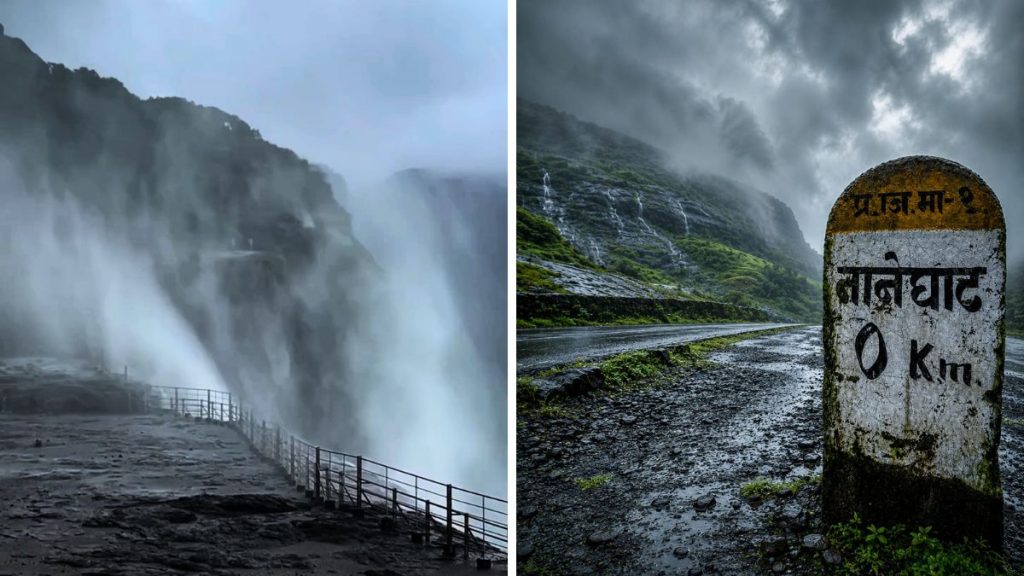
At Naneghat, waterfalls sometimes appear to flow upwards.
This remarkable “reverse waterfall” phenomenon, combined with more than 2,000 years of history, ancient cave inscriptions and one of India’s oldest trade routes, makes Naneghat far more than a monsoon getaway. It is a place where history, adventure and nature come together in unforgettable fashion.
Located about 120 kilometres from Pune and 165 kilometres from Mumbai, Naneghat lies near Junnar in the Sahyadri ranges. Every monsoon, powerful southwesterly winds rush through the narrow mountain pass. When these winds collide with waterfalls cascading down the cliffs, they push the falling water back into the air, creating the illusion that the waterfall is flowing upwards.
Although the water never truly defies gravity, the visual effect is extraordinary. Fine droplets swirl skyward, disappearing into drifting clouds before returning to the valley below. The phenomenon is most commonly witnessed during July and August, when the monsoon is at its peak.
Visitors often gather along the cliffs, cameras in hand, waiting patiently for the winds to perform nature’s magic. Yet no photograph fully captures the experience of watching water seemingly rise into the clouds.
To add to the mystisicm of this beauty, long before highways connected Maharashtra’s cities, Naneghat served as one of the most important mountain passes linking the Konkan coast with the Deccan Plateau.
Dating back over two millennia, merchants travelled this route carrying silk, spices, cotton, precious stones, metalware and other valuable goods between inland kingdoms and coastal ports. Before crossing the pass, traders paid a toll, known as “Nane” or coins, giving the route its name: Naneghat, meaning the “Pass of Coins.”
Standing on these windswept cliffs today, it is easy to imagine long caravans of traders, horses and bullock carts making the same journey centuries ago, connecting cultures and economies across ancient India.
One of Naneghat’s greatest historical treasures is its rock-cut cave, carved during the 1st century BCE under the Satavahana dynasty.
Unlike many ancient caves built solely for religious purposes, the Naneghat cave also served as a resting place for traders and travellers using the busy commercial route.
Its most remarkable feature is its collection of Brahmi inscriptions, including the celebrated inscription of Queen Naganika, wife of Satavahana ruler Satakarni. Historians regard it as one of India’s earliest inscriptions to prominently mention a queen, offering rare insights into royal lineage, governance, religious rituals and the political landscape of ancient India.
More than 2,000 years later, these weathered inscriptions continue to tell stories of a civilisation that once flourished in the Western Ghats.
From late June until September, Naneghat undergoes a dramatic transformation.
Dry rock faces become living waterfalls, valleys disappear beneath blankets of mist and every trail is painted in vibrant shades of green. Clouds drift through the mountain pass while streams rush over ancient stone pathways once walked by traders and soldiers.
The cool breeze, rolling fog and continuous rainfall create an atmosphere unlike any other in Maharashtra. Every bend in the trail reveals new viewpoints, hidden waterfalls and dramatic escarpments stretching across the Sahyadris.
For photographers, nature lovers and adventure seekers, the monsoon is undoubtedly the best time to experience Naneghat in all its glory.
The historic trekking route to Naneghat remains one of Maharashtra’s most rewarding monsoon treks.
Classified as moderately difficult, the trek typically takes two to three hours one way, depending on weather conditions and the trekker’s pace. During the rainy season, slippery rocks, flowing streams and dense fog make the journey both challenging and exciting.
Along the route, trekkers are rewarded with panoramic views of deep valleys, towering cliffs and the iconic rock pinnacle popularly known as “Nana’s Thumb,” standing like a natural sentinel overlooking the ancient pass.
Every step on this centuries-old pathway is a reminder that travellers have crossed these mountains for over two thousand years.
A visit to Naneghat can easily be combined with nearby historical landmarks, making it an ideal weekend itinerary.
Just a short drive away stands Shivneri Fort, the birthplace of Chhatrapati Shivaji Maharaj, where visitors can explore one of Maharashtra’s most significant historical sites. Nearby Jivdhan Fort, once an important watchtower protecting the Naneghat trade route, offers another rewarding trek with spectacular views of the surrounding landscape.
Together, these destinations showcase the rich historical heritage of the Junnar region.
The journey to Naneghat is as memorable as the destination itself.
Roadside stalls along the approach serve freshly prepared vada pav, crispy kanda bhajiyas, roasted corn seasoned with lime and spices, steaming cups of ginger tea and other local delicacies that perfectly complement the cool mountain weather.
Enjoying simple food while watching clouds drift across the valleys becomes one of the most cherished memories of the trip.
The best time to visit to visit and witness the natural phenomenon, i.e., Naneghat, is from late June to September, with the reverse waterfall most frequently visible during July and August.
Distance: Approximately 120 km from Pune and 165 km from Mumbai.
Route from Pune:
via Rajgurunagar – Manchar – Narayangaon – Junnar – Aptale – Ghathghar- Naneghat
Route from Mumbai: Kalyan – Murbad – Vaishakhare – Naneghat.
Trek difficulty: Moderate.
Approximate trekking time: Two to three hours (one way).
Responsible Tourism Matters
As Naneghat continues to attract increasing numbers of visitors each monsoon, preserving its fragile ecosystem has become more important than ever.
Travellers are encouraged to avoid littering, refrain from using single-use plastics, remain on designated trekking paths and respect the archaeological significance of the caves and inscriptions.
Protecting Naneghat ensures that future generations can continue to experience both its natural beauty and its priceless historical legacy.
Naneghat is more than a scenic viewpoint or a trekking destination. It is a place where ancient trade routes, royal inscriptions and extraordinary natural phenomena exist side by side.
As mist rolls across the mountains and waterfalls rise into the wind, visitors are reminded that some of the world’s most remarkable experiences cannot be measured in photographs alone. They are felt in the cool mountain breeze, heard in the echoes of history carved into stone and remembered long after the journey ends.
In the heart of the Sahyadris, where history still whispers and waterfalls seem to touch the sky, Naneghat continues to inspire every traveller who arrives with curiosity, patience and respect.