
Russian Luna-25 Spacecraft Sets Sights On Lunar South Pole: Race Against India’s Chandrayaan-3 Looms
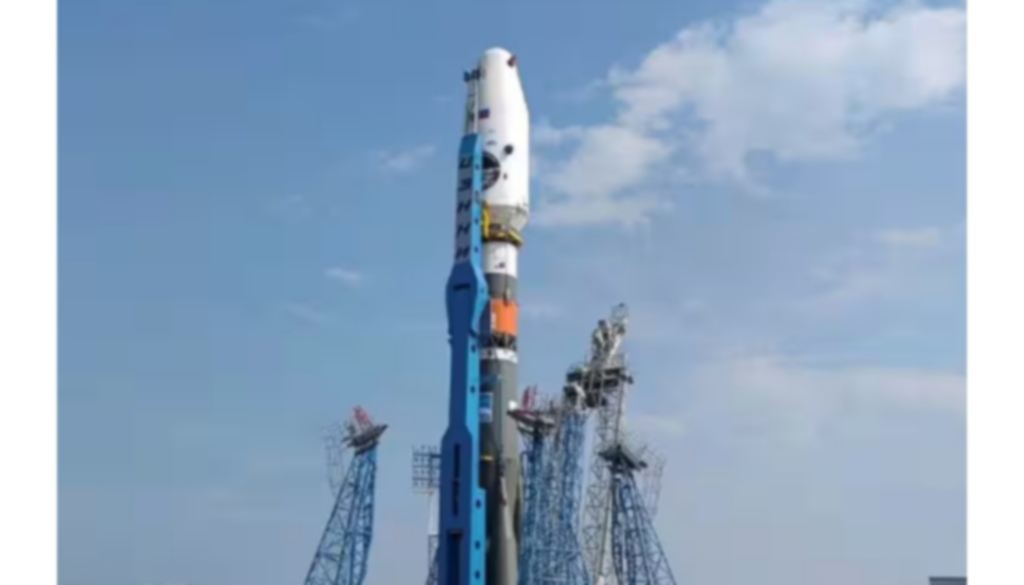
New Delhi, 12th August 2023: While the Indian Space Research Organisation (ISRO) diligently progresses through its month-long lunar journey, a Russian spacecraft, launched on Friday, has already fixed its gaze on the moon’s surface. Scheduled for a moon landing near the southern pole around August 23, the Luna-25 craft is synchronizing its efforts with the anticipated landing of Chandrayaan-3.
Unlike ISRO’s mission, the Russian lander and rover launched approximately four weeks later, are projected to expeditiously position themselves in a lunar orbit of 100 kilometres by August 16. Their objective is to potentially achieve a south pole moon landing between August 21 and 23. Notably, there’s a reasonable probability that the Russian spacecraft could touch down on the lunar surface before Chandrayaan-3. However, beyond the timing of the landing, the two missions diverge in their design and goals.
One intriguing aspect that has puzzled observers is how the Russian spacecraft could traverse the 384,000-kilometer distance to the moon within a mere six to seven days, outpacing ISRO’s month-long journey. This discrepancy arises from ISRO’s unique approach in comparison to global space powers like Russia, China, and the US. India adopts a phased approach, executed over up to 40 days, as opposed to a direct journey.
ISRO’s path to the moon involves launching its rocket from Sriharikota, placing the spacecraft into an elliptical orbit around Earth. Gradually, through a sequence of controlled manoeuvres, scientists at ISTRAC in Bengaluru elevate the spacecraft’s orbit incrementally. This orchestration continues until Chandrayaan-3’s orbit is gradually lowered, positioning it over the lunar poles. This intricate series of steps culminated in a successful injection of the spacecraft into the lunar orbit on August 5. Subsequent manoeuvres will further refine its orbit until it attains the desired polar orbit, paving the way for an attempted soft landing on the moon’s south polar region on August 23.
In contrast, Russia’s rocket takes a more direct route to the moon’s trans-lunar orbit, resulting in a faster journey compared to India’s method.
The primary reason for this difference lies in the formidable rockets possessed by other spacefaring nations, such as Russia, China, and the US. Their powerful rockets, like Russia’s Soyuz 2.1, China’s Long March series, and SpaceX’s Falcon series, boast substantial fuel capacity and advanced engines. These rockets are capable of propelling spacecraft directly to the moon, bypassing extended orbits around Earth. In contrast, ISRO’s most powerful rocket, the LVM-3 (GSLV MK3), possesses lesser fuel capacity and thrust. Additionally, its payload capacity limitations constrain its ability to undertake swifter interplanetary missions.
While there’s a likelihood that Russia’s lunar spacecraft might accomplish its landing before Chandrayaan-3, both missions serve distinct research objectives and employ varying strategies. As of July 2023, there exist six operational lunar orbiters, with the inclusion of Chandrayaan-2’s orbiter, which was launched in the year 2019.